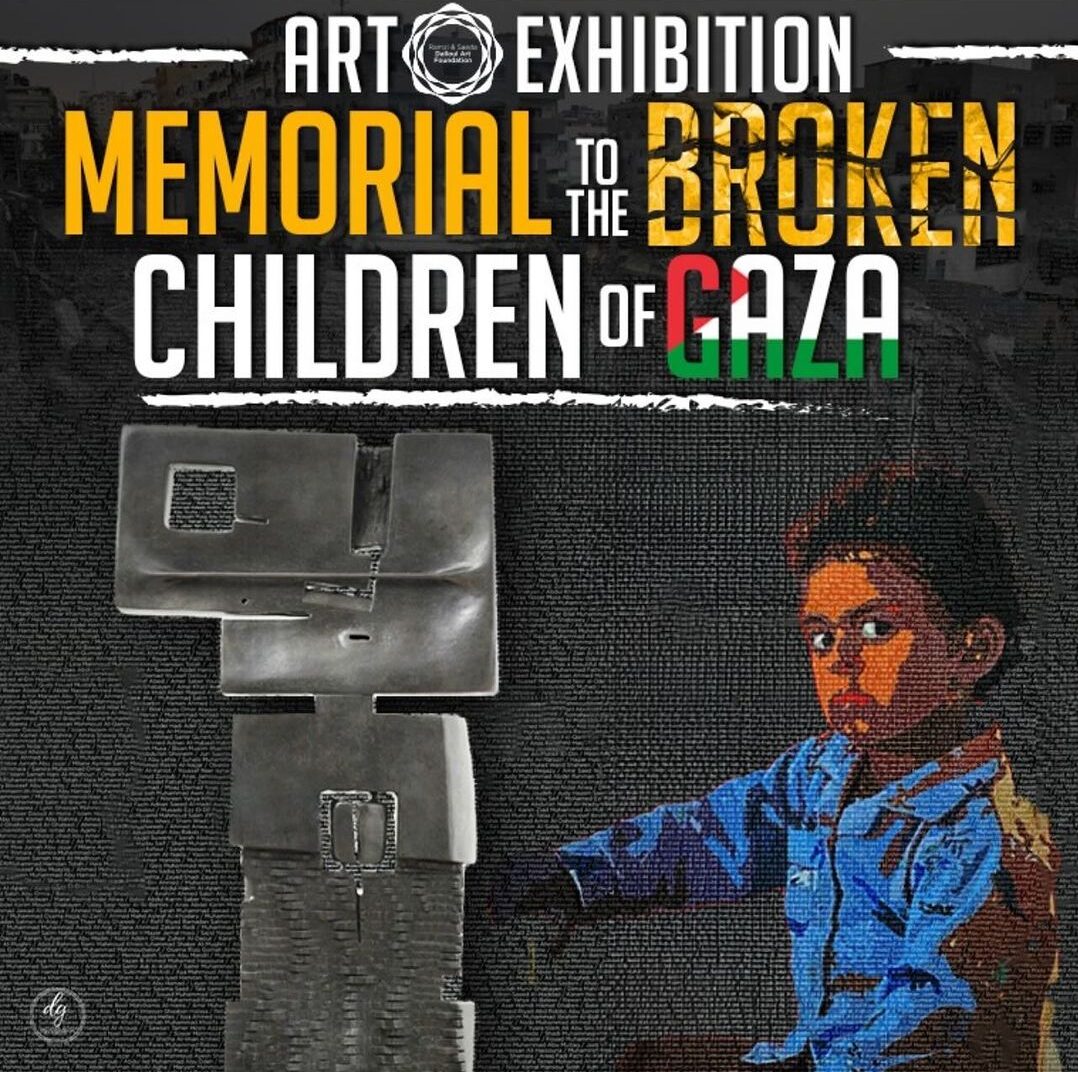
ART EXHIBITION MEMORIAL TO THE BROKEN CHILDREN OF GAZA
March 17, 2024A SPECIAL REPORT BY DAIZY GEDEON
The Dalloul Art Foundation in Beirut recently launched an art exhibition dedicated to the children of Gaza who have been the greatest victims of this recent and most devastating battle against teh Israeli occupying army in Gaza.
Titled The Little Prince of Gaza, it captures and showcases artwork over more than 75 years by Palestinian and Arab artists who have been documenting the heart-breaking story of Palestine and its people.
Creating artwork that gives witness to an enduring calamity that, until that horrific event on October 7, 2023, the world had been misguided and misinformed about, but one that since October 8, and every day since then, we have become awoken to.
The exhibition has been extended until April 15th and I recommend anyone who happens to be in Beirut to lend your eyes to this this impressive collection and devastating story.
Location: White Tower Building, Mme Curie, 2nd Floor, Beirut, Lebanon
@dafbeirut @thawra.tv @tarekhmaydan
If you advocate for TRUTH & JUSTICE, SHARE to spread the knowledge.
#dafbeirut #Palestinianart #infitadaart #FreeGaza #PalestineSolidarity #GazaGenocide #UNRWA #EndGenocide #Palestine #ICJJustice #ceasefirenow #FreePalestine #Interfaith #StandWithUs #Truth #Palestine #Gaza #Humanrights #Israel #فلسطين #اسرائیل #غزة #airdropaidforgaza #middleeast #egypt #truth #fact
English Script:
Daizy: For more than 75 years, artists have been documenting the heart breaking story of Palestine and its people. 75 years of capturing scenes, faces, expressions, logging the pain, sorrow, hardship, documenting the tragedy, abuse, subjugation, persecution and thousands upon thousands of deaths, murders and torture. Creating artwork that gives witness to an enduring calamity that until that horrific event on October 7, 2023, the world had been misguided and misinformed about, but one that since October 8, and every day since then, we have become awoken to. But also, artwork that demonstrates the defiance, determination and eternality of the Palestinian people’s will to survive. In Beirut, less than 300 kilometers from Ground Zero in Gaza, the Dalloul Art Foundation, home to possibly the widest and most erudite collection of Palestinian and Arab art in the world, launched the Little Prince of Gaza exhibition last December, showcasing timeless pieces of art that convey this historic struggle in a manner that no words could ever relay. At the center of this exhibition is the powerful sculpture by Chaouki Choukini, titled Small Prince: Child of Gaza, Curated by DFA’s founder and chairman, Dr Basel Dalloul, and coordinated by head of research Wafa Roz, this unique exhibition was inspired by the tragic destruction and unparalleled loss of life that the people of Gaza have experienced for more than six months. Conceived as a memorial to the more than 13,000 Palestinian children who have so far lost their lives since the state of Israel launched its merciless and inordinate retaliation to the October 7 Hamas attack, the show was divinely guided as Dr Dalloul explained.
Basel Dalloul: I’ll tell you how this whole thing came about when we had this recent auction called Marhala at Christie’s in London. One of the pieces that was chosen for this was this particular sculpture by Chaouki Choukini and the name of the sculpture is Le Petit Prince, L’enfant de Gaza. The Little Prince, the Child of Gaza. This goes to London, and Wafa and I are both really sorry because of what had taken place, that this piece was actually going, because it would have, you know, been kind of significant for something we would have thought of doing for what was going on.
Wafa Roz: This piece did not sell. And we were in the cab the last day. And I looked at Basel and told him this is coming back home for a reason. And it all started like that. I thought, why don’t we create a memorial?
Basel Dalloul: So this one was meant to come home.
Wafa Roz: And as you can see, it adopts the cubist formation. So the head is deformed. The eye, if you see from the front side, is to the left distorted and it’s fragmented salvation Chaouki Choukini had in mind in 2010, to send a message about the fragmentation and disjointedness of the children of Gaza in their daily life. It ended up today, not only about the fragmentation of their lives, it’s the fragmentation of their limbs, of their bodies, of their families. Everything that would relate to a livelihood, psychological, political, social, physical, mental has been fragmented.
Basel Dalloul: So I said, well, you know, they’re turning us into numbers. Let’s turn these into humans. So you see on the platform here, this is really, this is like a monument to these children. So these are the names of the children that we got from the Ministry of Health in Gaza who have died.
Wafa Roz: To have some kind of a pedestal plate, a flat gray stone where someone would enter and feel some kind of serene silence that is even more powerful than the whole noise happening in the world.
Daizy: Walking through the gallery, you begin to get a sense of the enormity of the adversities the Palestinians have endured over the past nearly eight decades and their resourcefulness to survive under hostile oppression. One piece by world renowned Palestinian visual artist, the late Laila Shawa, captured the daily struggle of Palestinians simply trying to communicate with one another, which the Israeli occupiers tried to prevent by cutting people off from each other and making their lives a living hell. Laila Shawa was born in Gaza in 1940 and passed away in 2022. She used the graffiti Palestinians painted on walls to send messages to one another to capture a period of time and a practice that Palestinians were forced to resort to, so it would never be forgotten or lost.
Wafa Roz: Laila was so much inspired by the graffiti that the normal people used to send messages to each other in Gaza because they were not allowed to use any communication means. So what they used to do is send messages to each other by the way, through the graffiti. What the Israelis ended up doing, and this is something that Hani Zurob, another Palestinian artist narrates, is that they started painting all the walls with tar so that even this kind of communication is hindered and deprived. What Laila did, a long time ago, she went down to the streets with a photographer, a friend of hers, and she started photographing all of those graffiti walls and started decoding those messages.
Daizy: The exhibition features artwork that illustrates the historic struggle and defiance of the Palestinians of the past 100 years, including the era of PLO Chairman Yasser Arafat and back to the days of the 1948 Nakba, as well as the symbolic painting of the man wearing the Kefeyyah, which has now become synonymous with peace for all of humanity, following the awakening of billions of people to the uncensored truth of the Palestinian plight.
Bassel Dalloul: In the history of Palestinian modern art, this is probably the most iconic artwork out there, and it’s called Jabal Al Mahamel which is he’s carrying the burden of Jerusalem on his back.
Daizy: Would you say that this gallery and your exhibition are a historical, creative documentation, artistic documentation of the Palestinian crisis?
Wafa Roz: I would say yes and most importantly, they are focused on the main theme, which is the children of Gaza. So it’s a symbolic installation that not only a ceasefire has to take place, the whole idea of genocide, of ethnic cleansing, of erasing away the lives or the meaning of someone to be human is unacceptable.
Daizy: As the world continues to rail in horror at the daily count of lives lost in Gaza, more than two thirds of them women and children.
Protestors: Free free Palestine. No more money for Israel’s crimes. No more monet for Israel’s slaughter.
Daizy: People from all walks of life, nations, faiths and beliefs have been responding in ways that give hope and restore faith.