
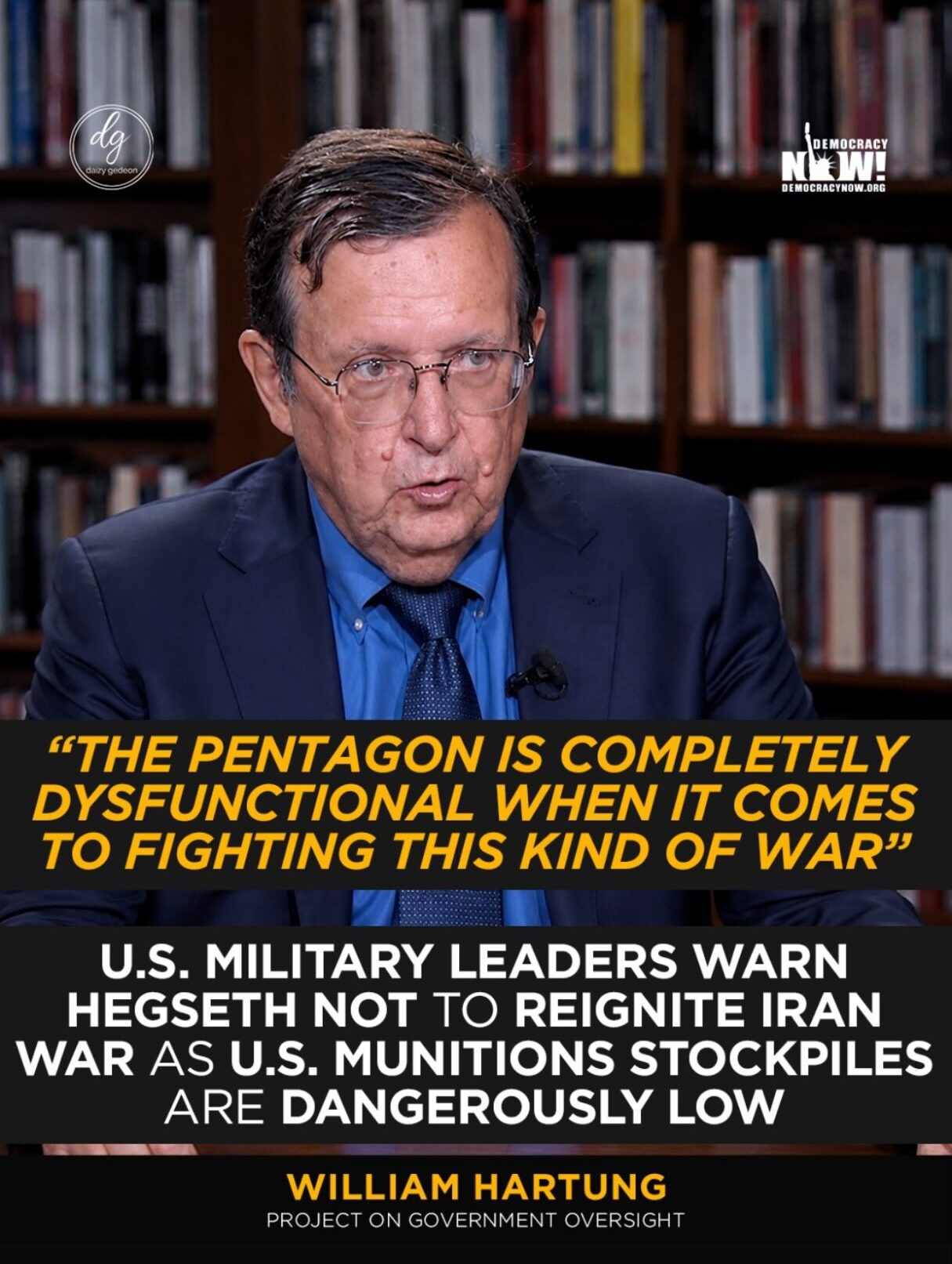
U.S. Military Leaders Warn Against Renewed Iran War as American Munitions Stockpiles Run Low
September 3, 2026
Top U.S. military commanders have reportedly issued a classified warning to Defense Secretary Pete Hegseth against expanding war operations against Iran, warning that six months of relentless conflict have severely depleted America’s global stockpiles of critical munitions.
Speaking on Democracy Now!, defense analyst William Hartung from the Project On Government Oversight (@pogowatchdog ) laid bare the underlying crisis: “The Pentagon is completely dysfunctional when it comes to fighting this kind of war.”
A war isn’t measured only by battlefield victories.
It’s also measured by what it costs, what gets depleted, and whether a country can afford to keep going.
EXPOSE THE WAR MACHINE. END U.S. INTERVENTION.
Report & Interview via @democracynow | Featuring @pogowatchdog
#fyp #WilliamHartung #Pentagon #StopUSWarMachine #NoWarOnIran #usa #america #petehegseth #war #palestine #battlefield
English Script:
Interviewer: Several U.S. military leaders have advised Defense Secretary Pete Hegseth against extending the war in Iran because the six month old war has degraded the military’s ability to confront threats elsewhere. This comes after multiple reports have revealed the U.S. is facing an ammunition shortage. What is the real reason for this shortage, and do you believe there is one bill?
William Hartung: Too many wars. I mean, if you’re going to arm a genocide waging legal war in Iran, the prior arming of Ukraine, are you going to run out of munitions? And, of course, these interceptors are dealing with drones that cost tens of thousands. It costs millions. So the Pentagon is completely dysfunctional when it comes to fighting this kind of war. They have depleted some of these things to some degree, perhaps a third to a half. But the reason they’re saying this is because they won’t be ready for a war with China. We have a war with China. We’re in deep, deep trouble. You know, an Iranian drone might cost 30 or $40,000. A cruise missile is 2 million. Some of the Patriot interceptor batteries are over 10 million. 10 billion. Rather. The THAAD missile defense system. The full battery could be 18 billion. So the so-called cost exchange ratio is not in the US favor. And of course, these things take time to build. So it’s great as a moneymaking machine for the weapons industry, but it’s not any way to wage a conflict. Of course, a conflict that shouldn’t have been started in the first place.


