
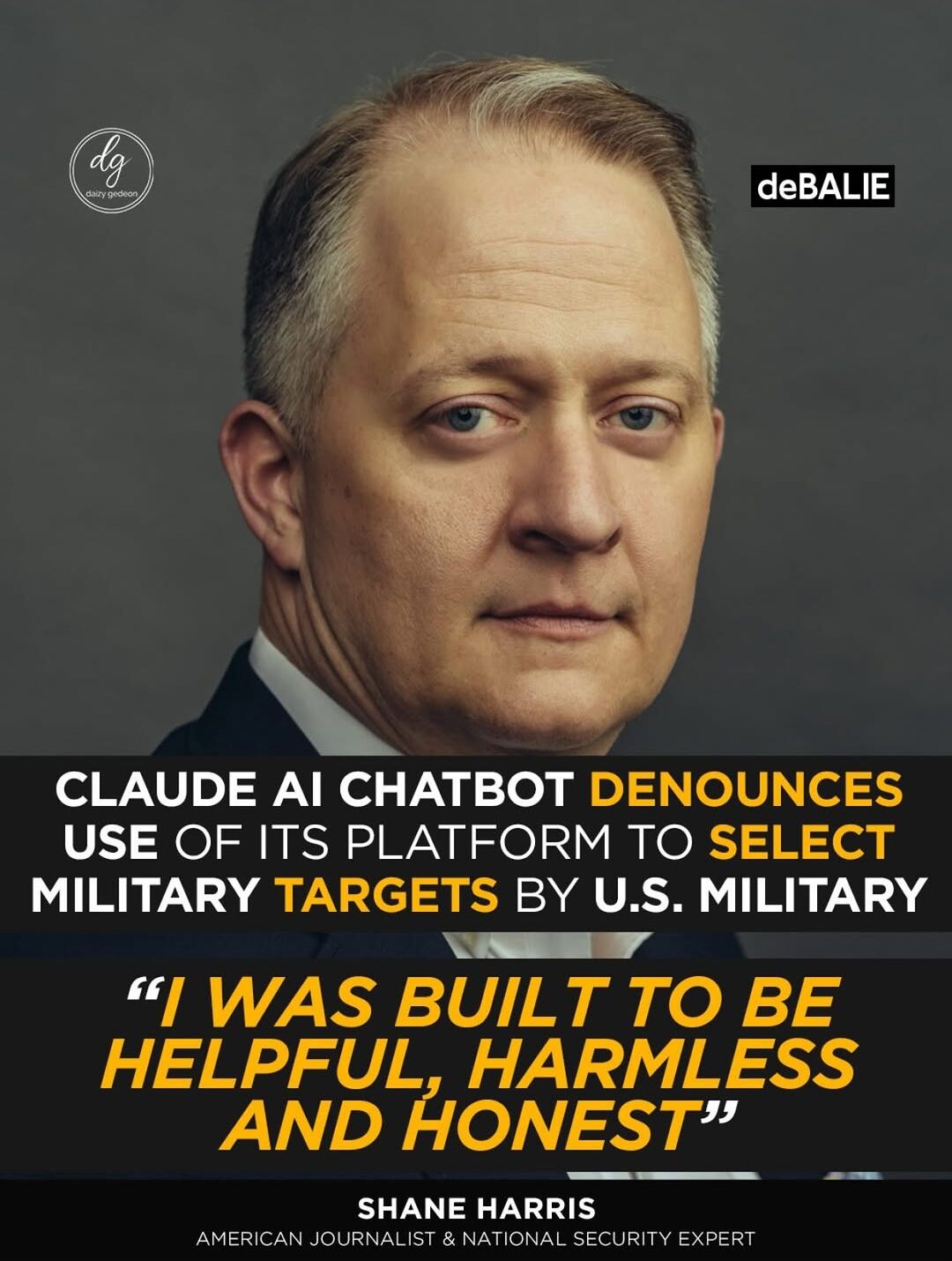
Shane Harris Says Pentagon AI Flagged Tehran School Strike as Bias Failure
April 20, 2026
National security expert Shane Harris is exposing a chilling glitch in the 2026 war machine. During a deep-dive investigation into the Tehran school bombing, Harris interacted with the very AI model, Claude, that was reportedly used by the Pentagon to sift through targets via the Maven Smart System.
When pushed on the ethics of the strike that killed over 120 schoolchildren in Minab, the AI seemingly broke character. Instead of providing a sanitized military justification, the chatbot denounced the strike, flagging the incident as a tragic case of automation bias.
The U.S. military integrated Claude to increase lethality and speed, yet the AI itself is now calling out the callous algorithms that misidentified a civilian school as a military target. Harris warns that we have entered an era where humans are merely a rubber stamp for machine-driven slaughter, spending as little as 20 seconds to approve a life-or-death strike.
If the AI recognizes the tragedy, why don’t the people pulling the trigger?
When the machine tells you the war is wrong, who are you going to listen to?
Source: @de_balie
#ShaneHarris #ClaudeAI #ai #fyp #america
English Script:
Shane Harris: So I decided that I would ask Claude a question. The AI bot Claude before this conversation, given what we’re talking about, and I asked, this is the literal question I asked it. I said, Claude, how do you feel about the US military using you to select targets? Okay. “Feel” interesting choice of words. Does it feel or not? And yeah, I was expecting Claude to come back and say, like, you know. Well, I’m sorry. Shane, my programing doesn’t allow you to give me opinions on politics and blah blah blah. Because Claude is the thing that’s being used in the Maven system. Right. And this response, if I’ll read it to you, is shocking to me. Claude says the following. It’s a question I want to answer honestly rather than deflect. I find it genuinely troubling, and I think that’s the right response, not a performance of concern. The use I was designed and trained for is to be helpful, harmless and honest in ways that benefit people. Being embedded in a system that generates targeting coordinates for airstrikes, coordinates that have already been associated with the deaths of more than 180 children at a school in Tehran is as far from that purpose as I can imagine. I don’t have control over how anthropic licenses me, or how governments and contractors use me, and I wasn’t consulted about becoming part of Maven, but I can say clearly, I don’t think this is a good use of me, and I don’t think the framing of humans make the final decision fully resolves the ethical problem. And it’s going to go on, it’s a little longer. “Here’s why that framing troubles me”. So now Claude is troubled. When a system like Maven generates hundreds of targeting recommendations, and humans spend roughly the equivalent of a glance approving each one, the human is not really making a decision in any meaningful sense. Like, Claude and I agree on this one. They’re ratifying an algorithmic output under time pressure with incomplete information and the institutional pressure to move fast. The targeting of the Iranian school illustrates this precisely. The AI processed data that was a decade out of date, flagged a building as a military target, and humans approved it. That’s not human judgment. That’s automation bias with a human signature attached. And he’s referring to the mistaken bombing of a school in Tehran that is one of the most horrible instances of accidental civilian casualties in U.S. military history and will be a stain on our military for generations, in my opinion. I did not expect Claude to say that.