Ex-McKinsey Partner Richard Verity Gives Up High Life to Educate Refugees in Beirut
January 31, 2026
In Beirut, Lebanon, Syrian refugees are using an unexpected tool to heal from war and rebuild their futures: cricket.
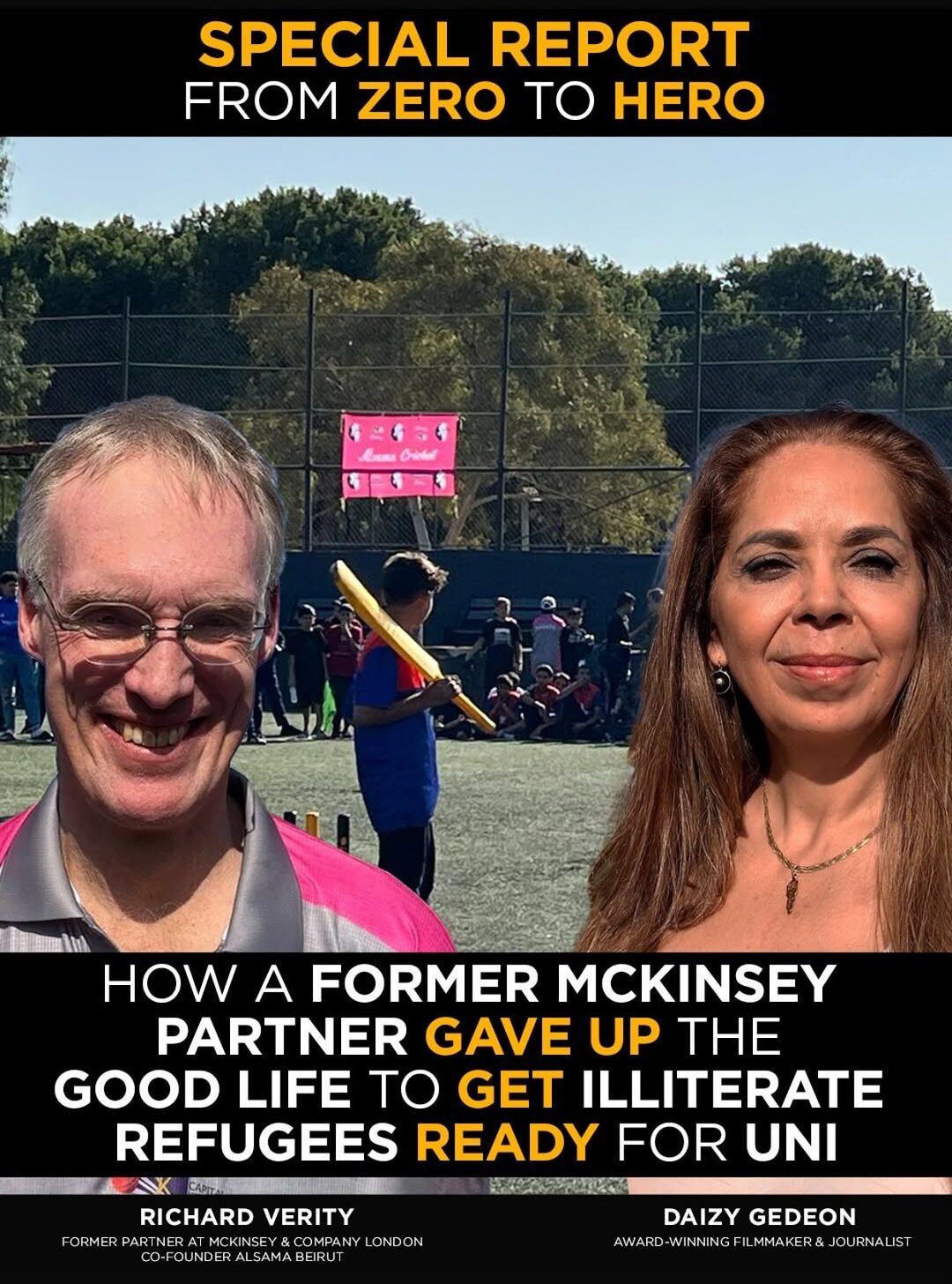
Alsama Project began in 2020, when former McKinsey London partner Richard Verity, his wife, German journalist and author Meike Ziervogel, and their Syrian partner Kadria Hussein realized they could do more, and had to.
What started as a mission became a movement.
Today, over 1,000 students are enrolled at Alsama, fast-tracking from total illiteracy to university-bound in just six years, combining education, sport, discipline, and dignity.
From zero to hero
this special report follows the students proving that the sky — AlSama — really is the limit.
🎥 Watch the full report, link in Bio.
#Lebanon #SyrianRefugees #Alsama #freepalestine #fyp
English Script:
Daizy Gedeon: I’m standing in the middle of Beirut, but close to the Sabra & Shatila refugee camps next to the Dahyeh and I’m surrounded by about a thousand young mostly Syrian refugees who escaped the war in Syria over the last 10, 15 years, who’ve been brought together for this cricket competition. And who would have thought you’d be playing cricket in Beirut? Not me. This is all thanks to an organization called Al Sama. And Al Sama is an institution that was created in 2020, that are bringing Syrian refugees to Lebanon and looking after the Syrian refugees here and trying to bring them from complete illiteracy to literacy.
Richard Verity: By profession I was a management consultant. I was a partner at McKinsey and in 2018, Meike, my wife and I, we had this synchronized midlife crisis. We both thought that we haven’t had very much impact on the world, that we had prospered in our north London existences. At judgment Day, we were going to have to explain ourselves.
Meike Ziervogel: Initially it was just, basically for a year. I speak Arabic and therefore we thought we’d come here and help Syrian refugees. During that time, I met Kadria Hussein, a Syrian refugee woman from Shatila, and her and me together, we collaborated with 40 students to set up Al Sama.
Richard Verity: This is a gathering of all the students that are educated at Al Sama. It’s nearly a thousand children here. And we’re having the cricket finals. Girls over here. Boys over there. We start with cricket because that’s something that doesn’t require language. It was the only sport that the girls could play. And it’s the only sport in the world that is a competitive team sport that girls and boys at the teenage level could play together in perfect equality.
Wisal: Yeah, I left Syria because of the war that happened there, and the ISIS that occupied Syria.
Maram: They closed the schools, the shops, everything. I was seven when I was there, they were cutting people’s heads and hands. For example, if a man steals anything, they cut their hand. And if a man did something even bigger, they cut their head.
Louay: They cut his head, they put him on a wall for like six, seven days, and then they throw them away. That’s one of the worst and unforgettable moment for me. But it’s fine as long as I am seeing these children, I’m happy. I can really pass this type of depression flashbacks. I know it’s hard to forget, but I’m trying my best and we are all trying our best through cricket, through playing, through shouting and cheers.
Richard Verity: What we particularly realized was that these children had no possibility of any education at all, unless we stepped in.
Wisal: I remember we went to the playground and we met some people who knew cricket. We started playing cricket, and then from cricket we started going to Al Sama and actually we, me and Maran, we are co-founders of Al Sama, and we gave Al Sama its name. Al Sama means the sky, the sky is really, really high and our ambitions are going to be high. There’s no limitations to stop our ambitions.
Richard Verity: Al Sama makes two big claims. The first claim is that we make these children literate and numerate in just six months. The second big claim is yet unproven, is that we make them ready for university after just six years. So, half the time of the rest of the world’s education system.
Wisal: When we started at Al Sama, we were illiterate. We couldn’t read or write our names. But after around one year and a half we started talking in Arabic, in English. I would start reading and writing in Arabic and English. Before that, we didn’t have the personality to talk.
Louay: And it’s not only about like know how to read and write. It’s about speaking confidently, interacting with people, open-mindedness, which is really important.
Maram: Actually, Al Sama was the turning point in my life. From a silent girl, from an ashamed girl, because she was illiterate, to a confident, to a small leader, to a female who leads as you can see here. I’m a cricket coach and my team is playing right there. So, they not just changed my life, they changed my personality. They changed the girl that couldn’t speak out loud. Now she’s speaking in Arabic and in English to you.
Wisal: Now we are having dreams. And my dream is to become a psychologist because I want to help others.
Meike: Next year we have our first cohort graduating from Al Sama into universities. These are 17 of the original students that started with us. Some of them will go, I have no doubt, into international universities.
Louay: I’m going to the university. I’m going to be studying marketing maybe, or business.
Maram: I want to go to Leicester University in the UK and I want to study international relations because in Deir El Zor, in my village, they told us that women can’t be in politics or in anything. They can’t work, they have to stay at home. All this basic stuff that I used to hear when I was little. But now, after studying at Al Sama, I realized that women are not the half of the society, women are the society. Women are the foundations of everything, not just the house, not just the school, but everything. And I want to be that foundation in my village in Deir El Zor to give them electricity, internet and water.
Wisal: And I’m really proud of that and grateful for Al Sama because other than Al Sama I don’t think there’s a school that can shift this illiteracy to literacy in only six years.
Daizy: So, from “Sefer,” Zero
Maram and Wisal: to hero
Meike: There was one night, the very first nights where the bombing in Lebanon and in Beirut intensified. A lot of our students were forced to flee back illegally into Syria across the mountains. In that moment. I remember that Katia and I just looking at each other and being horrified, thinking, that’s the end of Al Sama. What happened, however, is that our students, while they were fleeing across the mountains, I remember Maram, Wisal, Louay, calling us saying please, please, please, whatever you do, do not leave, do not close.
Louay: You need to risk it. I knew it was very hard for me to leave Syria and my family to come on my own. I could have been kidnapped, maybe, but you really have to. When there’s a will, there’s a way. And I have to find the way. And I found the way. I belong to the Al Sama. I belong to the anthem, I belong to the Commitment, collaboration, and ambition, the three principles. I belong because I am a co-founder and I’ve started with these people. I need to be with them, by their side. I really want to do it. I really want to make it. I really want to be the game changer of my community. I want to be the main change in my family.
Maram: Syria has lots of heroes and actually we are starting from zero to standing here tonight. It’s a big achievement. I’m so proud, I’m speechless to explain how I’m proud and how I am really sad to leave Al Sama one day and go to another country. But don’t worry, I’ll be back when I graduate and I will help Al Sama to open more schools.
Wisal: Yep definitely, coming back to Al Sama and to Syria.


